Introduction
The chemical components of a chile pepper that cause the well-known burning sensation (usually referred to as pungency in the technical journals) are all members of a family of compounds known as
capsaicinoids. Capsaicinoids are very similar in structure, varying only by the length of a long hydrocarbon portion (that is, a portion containing only carbon and hydrogen atoms), and by the presence or absence of one carbon-to-carbon double bond in that hydrocarbon portion
(carbon-carbon double bonds and some of their implications are discussed a little farther along in this section).
Of the capsaicinoids, there are two compounds that are typically responsible for about 80-90% of the capsaicinoid content of a pepper (Ref 7, 437), and thus for most of the pepper's pungency. The common names of these two compounds are
capsaicin and dihydrocapsaicin. The balance of the pepper's capsaicinoid content is made up by one or more minor capsaicinoids, which are discussed in the next section. Numerous studies have shown that the two major capsaicinoids are also the two most pungent capsaicinoids.
The typical concentration of capsaicinoids in a given pepper and the typical ratios of the various capsaicinoids present vary from subspecies to subspecies, and sometimes even within subspecies (Ref 7, 437). This is intuitive enough, as some types of peppers are
hotter than others (varying total concentration), and some types of peppers seem to burn mainly on the tongue, while others burn in the back of the throat (different types of pungency, therefore varying capsaicinoid distribution).
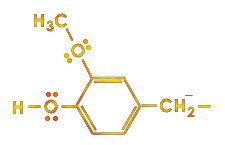
Capsaicinoids themselves are part of a larger family of chemicals known as vanilloids, which are compounds that contain the vanillyl group shown below. Vanilloids will be discussed in more detail later, as they are an interesting family
in their own right, and a survey of the vanilloids demonstrates a lot about how taste and odor perception work on a molecular level.
The vanillyl group, AKA the (4-hydroxy-3-methoxyphenyl)-methyl- group
All of the chemical structures and reaction mechanism diagrams used in this
section are my own creations. None of the chemical structures that I've seen on any other Chile Head sites show unshared electrons, nor do they properly depict the unsaturation in the
capsaicin molecule, both of which are major determinants of the chemical behavior of capsaicin. Due to the use of a really cheesy red-gold Chrome effect, all of my
technical artwork is readily identifiable (and hopefully too ugly to steal). If you see someone else using my artwork without giving proper credits, please 1) give them a boot in the
rear via email, and/or 2) let me know about it so I can do the same.
Last updated 31 January 2015.
(c) 1999-2026 Homestead Collective
All graphics (c) 1999-2026 Homestead Collective
Designed for Netscape 4+ and IE 4+ at 640x480 min. resolution with CSS and JavaScript enabled.
Hosted by the The Homestead Collective.